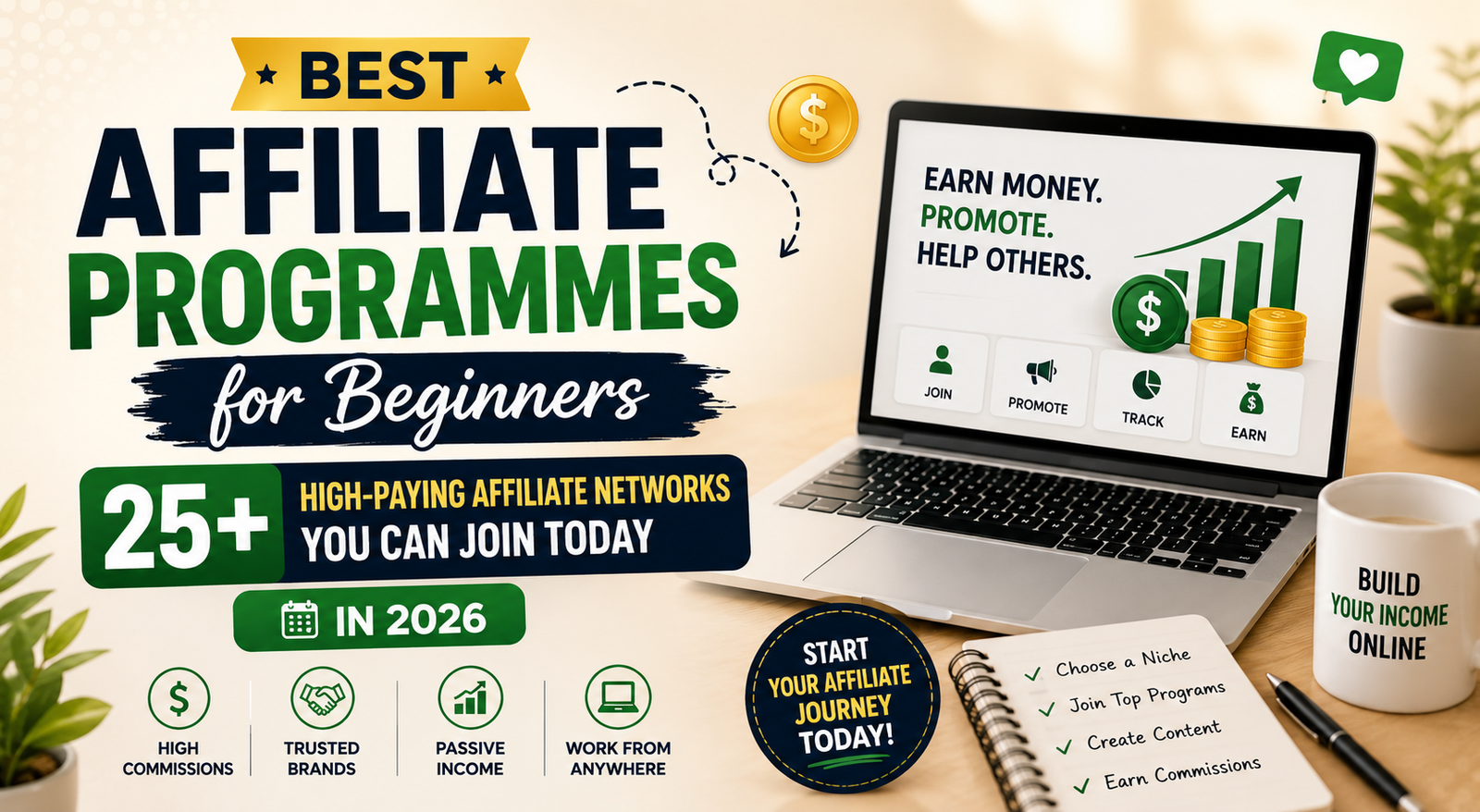
25+ High-Paying Affiliate Networks You Can Join Today in 2026
If you have ever wondered how bloggers, YouTubers, and Instagram creators earn money while they sleep, the answer is usually affiliate marketing. It’s one of the few online business models you can start with no money, no inventory, and no prior experience, and in 2026, there are more high-paying affiliate programmes for beginners than ever before.
This guide walks you through everything: what affiliate programmes are, how to choose the right ones, and a hand-picked list of 25+ beginner-friendly networks across retail, hosting, software, finance, AI tools and more. Whether you’re a student, a stay-at-home parent, or a creator building a side hustle, you’ll find something here you can join today.
Table of Contents
- Introduction
- What Is an Affiliate Programme?
- Can Beginners Really Make Money with Affiliate Marketing?
- How to Choose the Right Affiliate Programme
- 25+ Best Affiliate Programmes for Beginners
- Best Affiliate Programmes by Niche
- How to Join Affiliate Programmes
- How to Promote Affiliate Products
- Affiliate Marketing Without a Website
- Common Mistakes Beginners Should Avoid
- Tips for Increasing Affiliate Income
- Frequently Asked Questions
- Conclusion
Key Takeaways
- Affiliate marketing lets you earn commission by recommending products or services, no stock, no shipping, no customer service.
- You don’t need a website to start; Instagram, TikTok, YouTube and Pinterest all support affiliate links.
- The best affiliate programmes for beginners combine easy approval, fair commission rates, and products people already trust.
- Recurring commission programmes (like software subscriptions) tend to build more sustainable long-term income than one-off retail sales.
- Consistency and audience trust matter far more than follower count when it comes to converting clicks into commissions.
1. Introduction
Affiliate marketing is the practice of earning a commission by promoting someone else’s product or service. You share a unique tracking link, someone clicks it and buys, and you get paid, usually a percentage of the sale, sometimes a flat fee.
It remains one of the easiest online business models to start because the barriers to entry are so low. You don’t need to create a product, hold inventory, handle payments, or provide customer support. Most programmes are free to join, and many approve beginners with little or no audience at all.
The appeal for beginners is threefold:
- Low start-up costs: many creators start with nothing more than a free blog, a YouTube channel, or a social media account.
- Flexibility: you can promote products around a full-time job, studies, or childcare, and work whenever suits you.
- Passive income potential: once a blog post or video is published, it can keep generating commissions for months or years with minimal upkeep.
That said, affiliate marketing isn’t a get-rich-quick scheme. It rewards people who choose the right programmes, create genuinely useful content, and stick with it. This guide will show you how.
2. What Is an Affiliate Programme?
An affiliate programme is a formal arrangement where a company pays you (the affiliate) a commission for referring customers through a unique tracking link.
Key terms you need to know
- Affiliate link: a unique URL containing a tracking code that identifies you as the referrer.
- Cookie: a small file placed in the visitor’s browser when they click your link, which tells the merchant “this person came from you” for a set period of time (the cookie duration).
- Commission: the payment you earn, usually a percentage of the sale or a fixed fee per lead/signup.
- Conversion rate: the percentage of clicks that turn into actual sales or signups.
- Recurring commission: ongoing commission paid for as long as a referred customer keeps paying (common with software subscriptions), as opposed to a one-off payment.
The typical customer journey
- You publish content (a blog post, video, or social post) featuring your affiliate link.
- A reader or viewer clicks the link, and a tracking cookie is set in their browser.
- They complete a purchase or sign-up, sometimes immediately, sometimes days or weeks later, depending on the cookie duration.
- The merchant’s affiliate platform records the sale and attributes it to you.
- You earn a commission, which is paid out once you hit the programme’s minimum payment threshold.
3. Can Beginners Really Make Money with Affiliate Marketing?
Yes, but it’s worth separating myth from reality.
Myth: You need millions of followers to earn anything meaningful. Reality: A small, engaged audience that trusts your recommendations often converts far better than a huge, disengaged one. A blog with 500 monthly visitors searching for “best budget laptop for students” can outperform an influencer with 100,000 followers who never talks about tech.
Myth: Affiliate income is instant. Reality: Most beginners take weeks or months to earn their first commission, and longer still to build a reliable income stream. Search engines take time to rank new content, and audiences take time to build trust.
Myth: You just need to drop links everywhere. Reality: Consistency, honesty, and genuinely useful content convert far better than spammy link-dropping. Readers can tell when a recommendation is genuine versus when it’s purely commercial.
Realistic expectations: many beginners earn their first commissions within one to three months of consistent content creation, with income scaling gradually as content accumulates and search rankings improve. Six-figure affiliate incomes are achievable but typically take years of sustained effort, not weeks.
4. How to Choose the Right Affiliate Programme
Not all affiliate programmes are created equal. Before joining, weigh up:
- Commission rates, physical products (via retail marketplaces) typically pay 1–10%, while software and digital services often pay 20–50%, sometimes recurring monthly.
- Cookie duration, ranges from 24 hours (Amazon) to 365 days or lifetime (many SaaS and hosting programmes). Longer cookies mean more chances to get credit for a sale.
- Product quality, promoting products you wouldn’t be embarrassed to use yourself protects your credibility long-term.
- Brand reputation, well-known, trusted brands tend to convert better, especially for beginner audiences who are still building trust.
- Ease of approval, some programmes (like Amazon Associates) approve almost anyone; others require an established audience or website traffic.
- Payment methods, PayPal, bank transfer, and cheque are the most common; check which your programme supports before committing.
- Payment thresholds, the minimum amount you must earn before you get paid, ranging from $10 to $100+.
- Recurring vs one-time commissions, recurring commissions (common with subscription software) build compounding income over time, while one-off retail commissions reset with every sale.
5. 25+ Best Affiliate Programmes for Beginners
Note on figures: Commission rates, cookie durations and terms change frequently — Amazon, for example, revised several of its category commission rates in 2026. Always check the current terms on the programme’s official page before promoting.
Retail marketplaces
1. Amazon Associates Overview: The world’s largest online retailer’s affiliate programme, covering virtually every product category. Commission: Roughly 1–10% depending on category (rates vary by product type and are reviewed periodically by Amazon). Cookie duration: 24 hours (extends to 89 days if the item is added to cart). Payment: Direct deposit, cheque, or Amazon gift card. Best for: Beginners with review or “best of” content in any niche. Pros: Huge product range, high trust, easy approval. Cons: Short cookie window, relatively low commission on many categories. Difficulty: Very easy.
2. eBay Partner Network Overview: Affiliate programme for the global auction and marketplace site. Commission: Typically a percentage of the seller’s final value fee, varying by category. Cookie duration: 24 hours (extended for watched/bid items). Payment: PayPal or bank transfer. Best for: Deal, auction, and collectables content. Pros: Huge inventory including used and rare items. Cons: Payouts can be unpredictable due to variable fee-share structure. Difficulty: Easy.
3. Walmart Affiliates Overview: US retail giant’s affiliate programme, popular as an Amazon alternative. Commission: Typically 1–4% depending on category. Cookie duration: Around 3 days. Payment: Via Impact platform, direct deposit or PayPal. Best for: US-focused content creators. Pros: Strong brand trust, competitive pricing content converts well. Cons: US-centric, shorter cookie than some competitors. Difficulty: Easy.
4. Etsy Affiliate Programme Overview: Marketplace for handmade, vintage, and craft goods. Commission: Around 2–4% of sale value. Cookie duration: Around 30 days. Payment: Via Awin network. Best for: Gift guides, home décor, and craft niches. Pros: Unique product range, strong seasonal demand. Cons: Lower average order value than some marketplaces. Difficulty: Easy.
Web hosting providers
5. Bluehost Affiliate Programme Overview: One of the most popular WordPress hosting providers, often recommended to beginner bloggers. Commission: Flat fee per qualified signup, often in the region of $65+, with tiered bonuses for volume. Cookie duration: Around 90 days. Payment: PayPal or bank transfer. Best for: “How to start a blog” content. Pros: High flat-fee payouts, well-known brand. Cons: Requires audience genuinely interested in starting a website. Difficulty: Easy–moderate.
6. Hostinger Affiliate Programme Overview: Budget-friendly hosting provider popular internationally, including the UK. Commission: Percentage-based, often 60%+ of the sale value, with bonus tiers for higher performers. Cookie duration: Around 30 days. Payment: PayPal, bank transfer. Best for: International audiences, budget-conscious readers. Pros: High commission percentage, competitive pricing to promote. Cons: Payout tiers reward volume, which takes time to build. Difficulty: Easy. Invite friends and earn up to $260
7. SiteGround Affiliate Programme Overview: Premium WordPress hosting provider known for performance and support. Commission: Flat fee per sale, typically in the $50–100 range depending on plan. Cookie duration: Around 60 days. Payment: PayPal. Best for: Tech-savvy or business-focused audiences. Pros: Strong reputation, good conversion rates. Cons: Higher price point can mean fewer conversions from budget audiences. Difficulty: Moderate.
Email marketing platforms
8. ConvertKit (Kit) Affiliate Programme Overview: Email marketing tool built for creators and bloggers. Commission: Recurring, around 30% of subscription revenue for a set period. Cookie duration: Around 60–90 days. Payment: PayPal. Best for: Blogging and content creation niches. Pros: Recurring commission builds over time. Cons: Requires an audience interested in building an email list. Difficulty: Moderate.
9. GetResponse Affiliate Programme Overview: All-in-one email marketing and automation platform. Commission: Choice between a recurring model (around 33%) or a bounty model (flat fee per sale). Cookie duration: Around 120 days. Payment: PayPal, bank transfer. Best for: Marketing and business audiences. Pros: Flexible commission structure, generous cookie window. Cons: Competitive niche with many affiliates. Difficulty: Moderate.
10. AWeber Affiliate Programme Overview: Long-established email marketing platform. Commission: Recurring, typically around 30% of subscription fees. Cookie duration: Around 365 days. Payment: PayPal. Best for: Long-term content in the email marketing space. Pros: Very long cookie duration, recurring income. Cons: Smaller brand recognition than some rivals. Difficulty: Moderate.
E-commerce software
11. Shopify Affiliate Programme Overview: Leading e-commerce platform for building online stores. Commission: Flat bounty per referred merchant who signs up for a paid plan. Cookie duration: Around 30 days. Payment: PayPal. Best for: Entrepreneurship and business content. Pros: High-value payouts, strong brand trust. Cons: Requires a fairly warm, business-minded audience. Difficulty: Moderate.
Design tools
12. Canva Affiliate Programme Overview: Popular drag-and-drop design tool for non-designers. Commission: Recurring commission on Canva Pro subscriptions referred. Cookie duration: Around 30 days. Payment: PayPal. Best for: Design, productivity, and content-creation niches. Pros: Extremely well-known, easy to promote with visuals. Cons: Many free users never upgrade to paid plans. Difficulty: Easy.
Online learning platforms
13. Skillshare Affiliate Programme Overview: Subscription-based online learning platform with creative and business courses. Commission: Flat fee per new trial signup or subscription. Cookie duration: Around 30 days. Payment: PayPal. Best for: Creative, educational, and personal development content. Pros: Easy to promote via tutorials and “learn a new skill” content. Cons: Commission tied to trial conversion, which can be inconsistent. Difficulty: Easy.
14. Coursera Affiliate Programme Overview: University-partnered online course platform. Commission: Percentage of course or certificate purchases, typically 10–20%. Cookie duration: Around 30 days. Payment: Via Impact or PayPal. Best for: Education, career development, and upskilling content. Pros: High trust brand, wide course catalogue. Cons: Longer buyer consideration cycle for expensive certificates. Difficulty: Moderate.
Finance apps
15. Wise (formerly TransferWise) Affiliate Programme Overview: International money transfer and multi-currency account provider. Commission: Flat fee per qualifying transfer or account activation. Cookie duration: Varies, typically 30 days. Payment: Bank transfer. Best for: Travel, expat, and personal finance content. Pros: Trusted brand, useful for UK and international audiences. Cons: Financial services often require additional compliance disclosures. Difficulty: Moderate.
16. Revolut Affiliate/Referral Programme Overview: Digital banking and multi-currency card provider. Commission: Flat fee or reward per referred, verified signup. Cookie duration: Short, typically tracked via referral code rather than long cookie windows. Payment: Varies by scheme. Best for: UK and European finance and travel audiences. Pros: High relevance for UK creators. Cons: Terms and reward structures change frequently. Difficulty: Moderate.
AI tools
17. Jasper Affiliate Programme Overview: AI writing assistant for marketers and content creators. Commission: Recurring commission on referred subscriptions, often around 20–30%. Cookie duration: Around 30–45 days. Payment: PayPal. Best for: Content creation, marketing, and AI-focused niches. Pros: Recurring commission, growing category demand. Cons: Competitive, fast-moving AI tools niche. Difficulty: Moderate.
18. Semrush Affiliate Programme Overview: SEO and digital marketing toolkit. Commission: Flat fee per trial activation plus a percentage of subscription sales. Cookie duration: Around 120 days. Payment: PayPal. Best for: SEO, blogging, and marketing content. Pros: Generous cookie duration, well-regarded programme (BeRush). Cons: Requires an audience genuinely interested in SEO tools. Difficulty: Moderate.
Website builders
19. Wix Affiliate Programme Overview: Popular drag-and-drop website builder. Commission: Flat fee per premium plan referred. Cookie duration: Around 30 days. Payment: PayPal. Best for: “How to build a website” content. Pros: High per-sale payout, strong brand recognition. Cons: Requires visitors genuinely ready to build a site. Difficulty: Easy.
20. Squarespace Affiliate Programme Overview: Premium website builder popular with creatives and small businesses. Commission: Flat fee per new annual website or domain purchase. Cookie duration: Around 30–90 days depending on the network used. Payment: Via Impact, PayPal or bank transfer. Best for: Design-conscious and small business audiences. Pros: Strong brand, high-quality product to promote. Cons: Higher price point can mean a smaller buyer pool. Difficulty: Moderate.
VPN services
21. NordVPN Affiliate Programme Overview: One of the most recognised VPN brands worldwide. Commission: Percentage of sale, often tiered based on performance, plus recurring options via some networks. Cookie duration: Around 30 days. Payment: PayPal, bank transfer. Best for: Tech, privacy, and travel content. Pros: High conversion due to frequent promotions and brand trust. Cons: Saturated niche with heavy competition. Difficulty: Easy–moderate.
22. ExpressVPN Affiliate Programme Overview: Premium VPN service known for speed and reliability. Commission: Flat fee per sale, often tiered by subscription length. Cookie duration: Around 90 days. Payment: PayPal, bank transfer, Payoneer. Best for: Tech reviews and privacy-focused content. Pros: Generous flat-fee payouts. Cons: Premium pricing can limit conversions with budget audiences. Difficulty: Easy–moderate.
Productivity software
23. Notion Affiliate Programme Overview: All-in-one workspace and productivity tool. Commission: Percentage of referred subscription revenue. Cookie duration: Varies by partner network. Payment: Via partner network (e.g. PayPal). Best for: Productivity, students, and workflow content. Pros: Extremely popular tool with an engaged community. Cons: Programme access and terms can be more limited than larger networks. Difficulty: Moderate.
Travel booking platforms
24. Booking.com Affiliate Partner Programme Overview: One of the world’s largest accommodation booking platforms. Commission: Percentage of the booking value, typically in the 25–40% revenue-share range (of Booking.com’s commission, not the total booking). Cookie duration: Session-based, typically counted per visit. Payment: Bank transfer. Best for: Travel blogs and destination guides. Pros: Huge global inventory, trusted brand. Cons: Short attribution window compared with SaaS programmes. Difficulty: Easy.
25. Expedia Affiliate Programme Overview: Major travel booking platform covering flights, hotels, and packages. Commission: Percentage-based, varying by product type (hotels typically pay more than flights). Cookie duration: Around 7 days via most affiliate networks. Payment: Via network (e.g. Awin, CJ). Best for: Travel planning and itinerary content. Pros: Wide product range beyond just hotels. Cons: Flight commissions are typically very low. Difficulty: Easy.
Bonus picks
26. Awin, A large affiliate network hosting thousands of merchant programmes (fashion, finance, travel) under one dashboard; commission and cookie duration vary by merchant. Great for beginners who want to compare many brands in one place.
27. CJ Affiliate (Commission Junction), Another major network connecting affiliates with big-name retail and SaaS brands; ideal once you want to scale beyond a single retailer.
28. ShareASale. A beginner-friendly network with a huge range of small-to-mid-size merchants across niches like home, fashion, and health, often with easier approval than exclusive in-house programmes.
6. Best Affiliate Programmes by Niche
| Niche | Recommended programmes |
|---|---|
| Personal finance | Wise, Revolut, CJ finance merchants |
| Technology | NordVPN, ExpressVPN, Semrush |
| AI tools | Jasper, Semrush, Notion |
| Beauty | Awin beauty merchants, Amazon Associates |
| Fitness | Amazon Associates, ShareASale fitness merchants |
| Health | Amazon Associates, Awin health & wellness brands |
| Parenting | Amazon Associates, Etsy Affiliate Programme |
| Home & garden | Etsy, Amazon Associates, Awin home merchants |
| Fashion | Etsy, Awin fashion merchants, CJ Affiliate |
| Travel | Booking.com, Expedia, Wise |
| Education | Coursera, Skillshare, Notion |
| Business | Shopify, Semrush, Squarespace |
7. How to Join Affiliate Programmes
- Choose a niche. Pick a topic you know or genuinely enjoy, it will sustain your motivation far longer than chasing high commissions alone.
- Create a website or social media presence. Even a simple free blog, YouTube channel, or Instagram account is enough to get started.
- Apply to affiliate networks. Fill in the application form, including your website or social handle and how you plan to promote products.
- Get approved. Some programmes approve instantly; others review your content and traffic first. Be honest about your current audience size.
- Access your affiliate links. Once approved, generate unique tracking links from your dashboard.
- Track performance. Use each programme’s dashboard (and tools like Google Analytics) to see which links convert best, then double down on what works.
8. How to Promote Affiliate Products
- SEO blog articles, in-depth, search-optimised reviews and guides that rank on Google for years.
- YouTube videos, unboxings, tutorials, and comparison videos with links in the description.
- Instagram content, Stories, Reels, and link stickers featuring products in real use.
- TikTok videos, short, authentic demonstrations using the platform’s affiliate/shop features.
- Pinterest pins, evergreen visual pins linking to blog posts or products, ideal for niches like home and fashion.
- Email newsletters, curated recommendations sent directly to a warm, trusting audience.
- Facebook groups, community-driven recommendations (always following group and platform rules).
- Product reviews, honest, detailed breakdowns of pros and cons.
- Comparison articles, “X vs Y” content that captures high-intent searchers close to a purchase decision.
- Tutorials, “how to” content that naturally incorporates the tools or products used.
- Resource pages, a single page listing all your favourite recommended tools and products.
9. Affiliate Marketing Without a Website
You don’t need a website to start. Beginners can promote affiliate links directly through:
- Instagram: bio links, Stories link stickers, and Reels captions.
- TikTok: bio links and, where available, in-video shopping features.
- YouTube: links in video descriptions and pinned comments.
- Pinterest: pins can link directly to a merchant or to an affiliate link, depending on programme rules.
- LinkedIn: useful for B2B software and productivity tools.
- Email marketing: a newsletter platform and a simple sign-up page is enough to start building a list.
- Online communities: forums and niche communities can work well, provided you always follow platform and community disclosure rules.
10. Common Mistakes Beginners Should Avoid
- Promoting too many products, spreading yourself thin dilutes trust and focus. Start with one or two programmes you genuinely believe in.
- Choosing products solely for high commissions, poor-quality products lead to refunds, complaints, and lost credibility.
- Ignoring SEO, even great content won’t earn if nobody can find it.
- Not disclosing affiliate relationships, transparency is both a legal requirement (in the UK, under ASA/CAP rules) and a trust-builder.
- Expecting instant results, most beginners see gradual, not overnight, growth.
- Failing to build trust with an audience, recommendations only convert when people believe you.
11. Tips for Increasing Affiliate Income
- Build an email list early, it’s an asset you own, unlike social media followers.
- Create evergreen content that stays relevant and keeps earning for years.
- Optimise for search engines so your content keeps attracting new readers passively.
- Test calls to action, button wording, placement, and colour can meaningfully change click-through rates.
- Update old content regularly to keep information (and commission rates) accurate.
- Understand your analytics, know which pages, links, and programmes actually convert.
- Diversify affiliate partnerships so no single programme’s policy change can wipe out your income.
12. Frequently Asked Questions
What is the easiest affiliate programme for beginners? Amazon Associates is generally considered the easiest to get approved for, thanks to its broad product range and straightforward application process.
Do I need a website? No, many beginners succeed using Instagram, TikTok, YouTube, or Pinterest alone, though a website does help build long-term, search-driven income.
How much can beginners earn? It varies enormously, but most beginners start with modest earnings (often under £100/month) in their first few months, growing as their audience and content library expand.
Is affiliate marketing still profitable? Yes, though the landscape evolves, programme terms and commission rates change over time (as seen with recent Amazon Associates adjustments), so diversifying across multiple programmes helps protect your income.
Are there free affiliate programmes? Yes, the vast majority of affiliate programmes, including all those listed above, are free to join.
Can I do affiliate marketing on social media? Yes, and it’s one of the most popular routes for beginners, particularly on Instagram, TikTok, and Pinterest.
How long does it take to earn my first commission? This varies widely, but many beginners report their first commission within a few weeks to a few months of consistent content creation.
13. Conclusion
Affiliate marketing remains one of the most accessible ways to start earning online in 2026, but success comes from focus, not from joining every programme at once. Pick one or two trusted affiliate programmes that genuinely fit your niche and audience, create valuable content consistently, and prioritise helping your readers over simply selling to them. The commissions will follow.
Ready to get started? Subscribe to our blog for more affiliate marketing guides, explore our related posts on making money on Instagram and becoming a UGC creator, and download our free affiliate marketing starter checklist to take your first step today.
Related reading: How to Start a Blog for Beginners · How to Make Money on Instagram · How to Become a UGC Creator
External resources: UK Advertising Standards Authority (ASA) — affiliate marketing disclosure rules, official affiliate programme pages linked above for current terms and rates.