
Artificial intelligence is reshaping every market sector. Therefore, your investment strategy must evolve too. Here is exactly what you need to know.
The AI revolution is no longer a distant promise. It is, in fact, here right now and it is quietly rewriting the rules of investing. Consequently, those who adapt early will likely be far better positioned than those who wait.
For decades, a simple strategy worked well. Buy a broad index fund, hold it long-term, and reap the rewards. However, the AI era is fundamentally different from any previous technological cycle. As a result, the old playbook may no longer be sufficient on its own.
According to Fidelity’s Asset Allocation Research Team, AI now accounts for roughly 60% of recent U.S. economic growth. Furthermore, it is touching nearly every sector from energy to healthcare to real estate. In other words, this is not a niche tech story anymore. It is a macroeconomic force.
So, what should investors do? First, let’s understand the scale of what’s happening. Then, we’ll walk through the safest opportunities. Finally, we’ll cover the risks you absolutely must know about.

Why Your Investment Strategy Needs to Change Now
First and foremost, consider the sheer scale of AI capital deployment. Morgan Stanley estimates approximately $2.9 trillion will flow into global data centre construction alone through 2028. Moreover, this spending is feeding real industrial output not speculative paper gains.
Additionally, AI is now deeply embedded across the economy. Infrastructure, energy, semiconductors, logistics, and healthcare are all being transformed. Therefore, even investors with no interest in “tech stocks” are inevitably exposed to AI whether they realise it or not.
Furthermore, the pace of change is accelerating dramatically. As BlackRock noted, what was one cohesive trade for an entire decade software, semiconductors, and the Nasdaq has diverged by 60 percentage points in just four months. Consequently, broad index investing is no longer as diversified as it once appeared.
AI is the most powerful and far-reaching cycle of innovation and disruption seen in 25 years of following technology markets.” Adam Benjamin, Fidelity Asset Management
In short, the ground is shifting fast. However, that does not mean panic-selling everything. Instead, it means being more intentional and informed about where your money sits.
Safe(r) Investment Options in the AI Era
Importantly, “safe” in investing is always relative. Nevertheless, certain strategies carry considerably less speculative risk than others. Here are four well-supported approaches for 2026 and beyond.


Above all, Morgan Stanley’s 2026 strategy note recommends focusing on beneficiaries of national self-sufficiency trends, energy, critical materials, and AI infrastructure. These sectors benefit simultaneously from both the AI boom and geopolitical tailwinds.
Moreover, analysts at Janus Henderson point out that the AI buildout will cascade in phases. First, infrastructure enablers benefit. Then, well-positioned software providers gain. Finally, the broader economy captures the productivity upside. Therefore, investing across multiple phases of this cycle is arguably the most balanced approach.
Key Risks in AI Investment
Of course, where there is opportunity, there is also risk. Indeed, the AI investment landscape carries some very specific dangers that differ from previous tech cycles. Here are the four most significant ones.
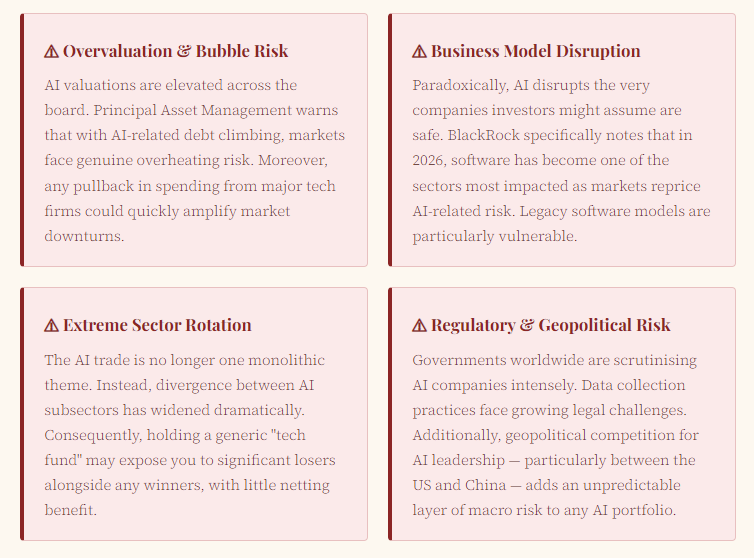
Furthermore, Principal Asset Management emphasises that 2026 requires a fundamentally different mindset than 2025. Specifically, investors must now focus on balance-sheet strength, earnings quality, and the durability of growth, not just momentum and enthusiasm.
What Should You Actually Do With Your Money?
Ultimately, the smartest approach is neither blind optimism nor fearful avoidance. Instead, it is deliberate, well-structured positioning. Here is a practical framework to consider.
Think in layers, not bets
Rather than picking a single winning AI stock, build exposure across layers. For instance, hold infrastructure plays for stability, ETFs for breadth, and a select few high-quality AI adopters for upside. This layered approach reduces concentration risk considerably.
Prioritise cash flow over hype
BlackRock is unambiguous on this point: treat AI as the defining variable, but only back companies that convert it into durable cash flow. High earnings growth and strong return on equity are the metrics that matter. Therefore, ignore price momentum in favour of fundamentals.
Don’t abandon diversification entirely
Even so, it would be a mistake to exit all non-AI positions. Instead, consider rebalancing gradually. Fixed income, international equities, and commodity-linked assets still serve important diversification roles, especially during AI sector volatility.
Stay informed, not reactive
Finally, the worst AI investors are those who chase headlines. Instead, review your portfolio quarterly with a specific lens on AI exposure. Ask whether your holdings are infrastructure enablers, AI adopters with pricing power, or simply hype-driven names with shaky earnings.
Key Takeaways for AI-Era Investors
- AI now drives roughly 60% of recent US economic growth it touches every sector.
- Infrastructure, energy, and physical AI backbone assets offer more stable exposure.
- Diversified AI ETFs reduce single-stock risk while maintaining thematic upside.
- Overvaluation, sector rotation, and regulation are the three biggest risks to monitor.
- Prioritise companies with strong cash flows, not just AI-adjacent buzzwords.
- Pair equity exposure with fixed income to manage portfolio-wide risk effectively.
- Review and rebalance quarterly the AI landscape shifts faster than any prior cycle.
The Bottom Line
The AI era is genuinely different. It is not just another tech cycle to ride passively. Instead, it is a structural economic transformation that rewards informed, deliberate investors and quietly penalises those who fail to adapt.
Fortunately, you don’t need to predict which AI company will “win.” Rather, you simply need to understand where the durable value lies: in the infrastructure that powers AI, the companies with pricing power that adopt it, and the portfolio discipline to navigate inevitable volatility along the way.
Therefore, start by reviewing your current portfolio today. Identify your AI exposure, both the opportunities and the vulnerabilities. Then, adjust thoughtfully, layer by layer.
Because in the AI era, the most dangerous investment strategy is doing nothing at all.
Disclaimer: This article is for informational and educational purposes only. It does not constitute financial advice. Always consult a qualified financial adviser before making investment decisions. Past performance is not indicative of future results. All investment carries risk, including the potential loss of principal.